


You can reach the point where you know something has to change… and still feel completely frozen.
Maybe you’ve already read about Opioid Addiction Treatment. Maybe someone you trust gently brought it up. Maybe a doctor used words that made everything feel suddenly real.
And now you’re sitting with a diagnosis, or a recommendation, and your stomach won’t settle.
If that’s you, we want you to hear this clearly:
Being nervous does not mean you’re not ready.
It means this matters.
Let’s talk through what that fear actually means—and what happens next.
The Fear Makes Sense
When people first reach out to us, they rarely sound confident.
They sound unsure. Guarded. Quiet.
They say things like:
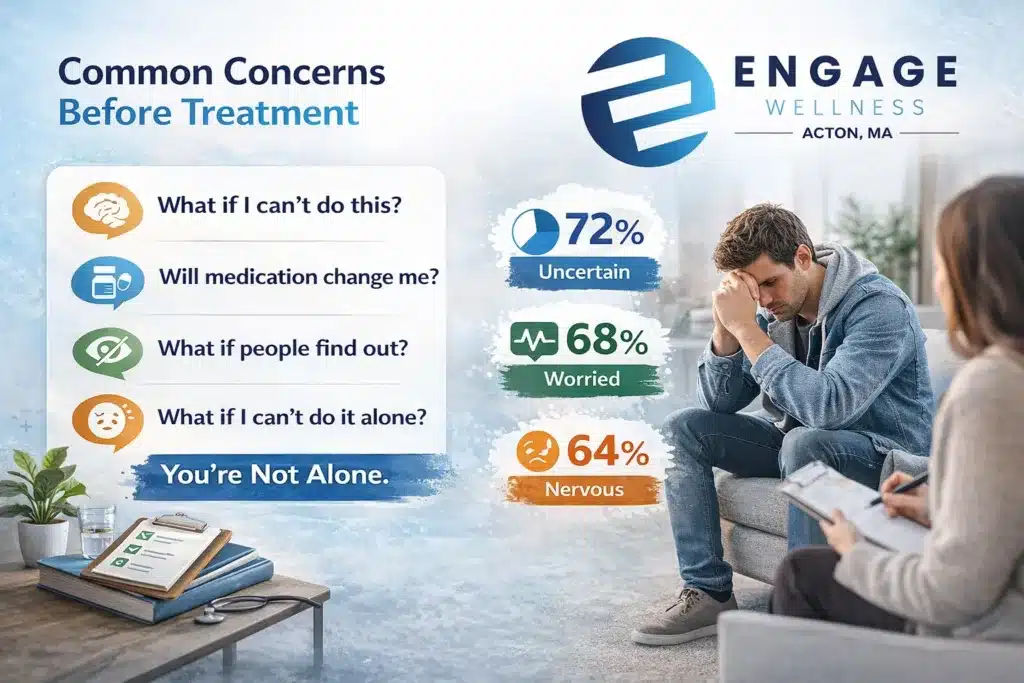
- “I don’t know if I can do this.”
- “What if medication changes me?”
- “What if I’m not strong enough?”
- “What if people find out?”
Fear shows up because this is vulnerable. You’re not just changing a habit—you’re confronting something that has shaped your daily life.
If you live in communities like Boston, Massachusetts, where people often feel pressure to keep it together, admitting you need help can feel especially exposing.
In nearby Westford, Massachusetts, we hear the same concern: “I don’t want this to define me.”
It won’t.
Seeking care doesn’t become your identity. It becomes part of your healing.
Fear doesn’t mean you shouldn’t go forward. It means you’re stepping into something important.
You’re Not “Giving In.” You’re Protecting Yourself.
There’s a myth that entering treatment means you failed at handling things on your own.
We see the opposite.
We see someone who has tried to manage it quietly. Someone who has held it together longer than most people realize. Someone who is tired of white-knuckling through cravings, anxiety, or shame.
Reaching out isn’t defeat.
It’s self-preservation.
Substance use often shrinks your world slowly. You cancel plans. You avoid conversations. You rearrange your schedule around using. Your energy narrows.
Choosing treatment widens it again.
You’re not surrendering your independence. You’re reclaiming your future.
It’s Okay To Be Scared Of Medication
If you’re newly diagnosed, medication may be the part that scares you most.
You might wonder:
- “Will this numb me?”
- “Will I still feel like myself?”
- “What if I depend on it forever?”
- “What if it doesn’t work?”
Those are intelligent questions.
Medication conversations should never feel rushed or forced. They should feel collaborative. You deserve to understand your options, the benefits, the risks, and the alternatives.
Our role is not to override your instincts. It’s to listen carefully and help you make informed choices.
You are not signing away your autonomy.
You are stepping into a conversation about what might help stabilize your body and brain so you can think clearly again.
Fear around medication is common. It doesn’t disqualify you from care.
It just means you need information and space to process.
You Don’t Have To Feel 100% Ready
Many people wait for certainty.
They tell themselves, “I’ll start when I feel more confident.” Or, “I need to be sure.”
But here’s the truth: certainty rarely comes first.
More often, there’s just a quiet realization: I can’t keep doing this.
That thought alone is enough.
You don’t need to promise lifelong sobriety. You don’t need to guarantee success. You don’t need to feel brave every minute.
You just need to be willing to take one step.
Courage is often quiet. It doesn’t look dramatic. Sometimes it looks like dialing a number with shaky hands.
That still counts.
The First Step Is A Conversation, Not A Commitment
When you imagine treatment, your mind might go straight to worst-case scenarios.
You may picture immediate, overwhelming change.
But the first step is usually much simpler than that.
It’s a conversation.
A chance to tell your story honestly. A chance to say what’s been happening. A chance to voice your fears without being judged.
From there, we look at options together. For some people, structured daytime care offers the support they need while maintaining daily responsibilities. Others may benefit from multi-day weekly treatment that allows them to stay connected to work or school. In certain situations, more immersive support may be recommended for a period of time.
There is no single track.
There is only the level of support that fits your current needs.
If you’re looking for support in Recovery, you can explore options through our support in Recovery page to see what aligns with your situation.
You don’t have to decide everything at once.
You just have to start the conversation.
What If It Works?
This is a quieter fear.
Sometimes people aren’t just afraid of failure. They’re afraid of change.
What if cravings decrease?
What if your mind feels clearer?
What if your emotions stabilize?
Relief can feel unfamiliar.
If chaos has been your baseline, calm may feel strange at first. You may not trust it. You may wait for something to go wrong.
That’s normal.
Recovery doesn’t erase who you are. It removes the fog so you can see yourself more clearly.
One client once told us, “I thought I was scared of treatment. I was actually scared of losing my excuse.”
That kind of insight doesn’t appear overnight. It grows slowly, in safe spaces.
And it often begins with simply showing up.
You’re Allowed To Want A Different Life
There is no rule that says you have to hit rock bottom before seeking help.
You’re allowed to want:
- More stability
- Better sleep
- Honest relationships
- A clear mind
- A future that feels possible
You’re allowed to want peace.
You don’t need to justify that desire. You don’t need to prove you’re struggling “enough.”
If you’re tired of feeling controlled by cravings or secrecy, that’s reason enough.
You deserve a life that feels steady.
What Happens After You Reach Out
When you call, you won’t be interrogated.
You won’t be judged.
You’ll talk to someone who understands that fear and hesitation are part of the process.
We’ll ask about your experiences. We’ll ask about your health history. We’ll ask what worries you most.
And we’ll listen.
From there, we’ll outline possible next steps. You’ll have space to ask questions. You’ll have time to think.
You remain part of every decision.
Treatment is not something done to you.
It’s something built with you.
You don’t have to wait for everything to collapse. You don’t have to wait for consequences to pile up.
If something inside you says, “This can’t continue,” that’s worth listening to.
You don’t have to be fearless to begin.
You don’t have to be certain.
If you’re nervous about starting opioid addiction treatment, you’re not alone. Many people feel exactly the way you do before they take that first step.
And many of them later say they wish they had called sooner.
When you’re ready to talk—even if your voice shakes—call (978) 699-9786 or visit our Opioid Addiction Treatment in Middlesex County, Massachusetts to learn more about how we can support you.