
Day Treatment
What Happens Each Day in a Day Treatment Program for Young Adults

Written By
Day Treatment
Written By
If your child is enrolled in a Day treatment program, you may find yourself asking the same question over and over—What does their day actually look like?
Not because you’re doubting the decision.
But because when your child is in crisis, not knowing can feel heavier than knowing something hard.
This guide is here to walk you through a typical day—not as a checklist, not as a clinical breakdown, but as a lived rhythm. One designed to help your child stabilize, feel supported, and slowly begin to trust themselves again.
One of the most important things a day treatment program provides is consistency.
For a young adult whose emotions, behaviors, or substance use have felt unpredictable—or frightening—structure can be deeply regulating. Days follow a familiar rhythm so your child doesn’t have to brace for the unknown at every turn.
This level of care is often chosen by families seeking meaningful support in recovery without full residential separation, and it’s especially effective when a young adult needs daily clinical care while remaining connected to their life outside treatment.
When your child arrives in the morning, the goal isn’t to demand engagement right away. It’s to help them arrive—mentally, emotionally, and physically.
Most mornings begin with:
This opening space allows nervous systems to settle. No one is asked to share more than they can. Silence is allowed. So is uncertainty.
For many parents, it’s reassuring to know that the day doesn’t start with confrontation or pressure—it starts with orientation and calm.
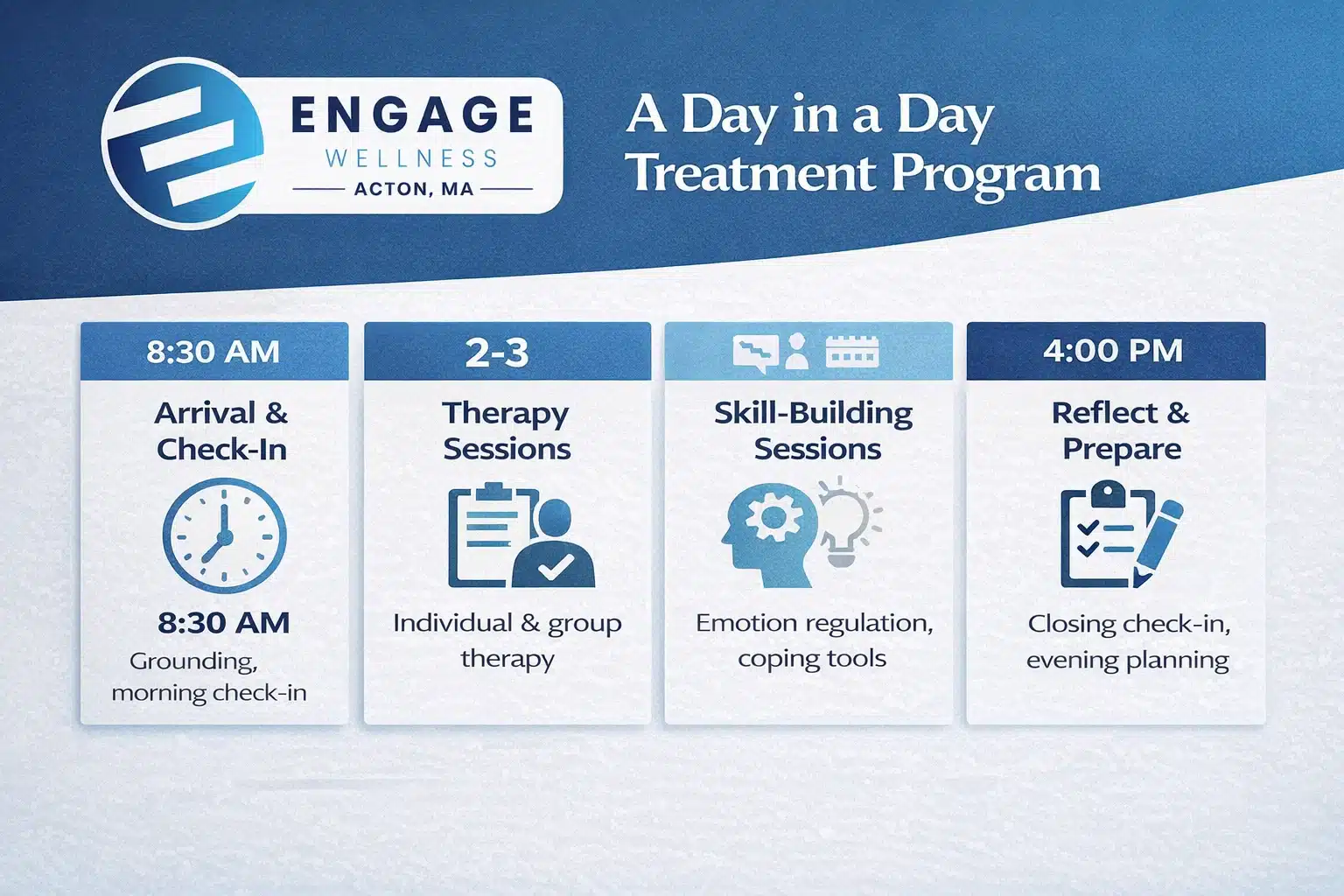
Throughout the day, your child will take part in a combination of individual and group therapy sessions. These aren’t designed to overwhelm or “break down” a person.
Instead, therapy is layered carefully.
Individual sessions provide a private space to:
Group therapy offers something different: shared experience. Hearing others name feelings your child hasn’t been able to put into words can be unexpectedly powerful.
In a day treatment program, therapy is meant to open doors—not force someone through them.
Many parents worry their child will spend all day talking about what’s wrong. In reality, much of the day is focused on learning how to cope differently.
Skills-based sessions may include:
These skills are practiced in real time, with clinicians present to guide and support. Your child isn’t expected to master them instantly—just to begin.
What makes this especially effective is that your child then returns home and practices those same skills in everyday life.
Healing doesn’t only happen during therapy.
A structured day treatment program includes:
For young adults in crisis, something as simple as eating regularly or sitting quietly without being “on alert” can be profoundly stabilizing.
Parents are often surprised to learn that these quieter moments can be just as important as formal therapy.
As the day progresses, the focus often shifts from exploration to integration.
Your child may work on:
This part of the day helps ensure your child doesn’t leave feeling raw or exposed. Clinicians help them close emotional loops before transitioning back into their evening routine.
In a well-run day treatment program, no one is sent home carrying more than they can reasonably manage.
Before leaving, your child usually participates in a closing check-in. This moment helps them:
This closing ritual matters. It signals that care doesn’t disappear just because the day is ending.
Many parents notice that over time, evenings feel slightly more manageable—not because everything is resolved, but because their child isn’t emotionally flooded when they come home.
For families navigating crisis, day treatment often creates space to breathe.
Parents frequently report:
This model is often chosen by families in Lowell, Massachusetts, who are looking for intensive support while maintaining family connection.
It’s also commonly accessed by families in Newton, Massachusetts, who want structured care that still allows young adults to practice recovery skills in real life.
One of the hardest parts for parents is recognizing progress when it doesn’t look dramatic.
Early signs may include:
These shifts are easy to miss—but they matter. Stabilization often comes before insight. Safety comes before growth.
A day treatment program is designed with this reality in mind.
It’s normal to want details. It’s also okay if you don’t understand every therapeutic choice.
What matters is knowing your child’s days are structured, supervised, and supported by professionals who understand crisis—not just clinically, but humanly.
Sometimes the greatest gift a program offers is time. Time for emotions to settle. Time for trust to rebuild. Time for your child to feel less alone in their own mind.
If your family is navigating a difficult moment and you want to understand whether this level of care is appropriate, guidance is available.
Call (978) 699-9786 to learn more about our Day treatment program in Middlesex County, Massachusetts and how we support young adults and their families through this stage of healing.
You don’t need certainty to move forward.
You just need enough support to take the next step.
Most day treatment programs run several hours per day, typically five days a week. The exact schedule varies, but the structure is consistent to provide stability.
No. A day treatment program offers a higher level of care than standard outpatient therapy, with multiple daily therapy sessions and clinical oversight.
Yes. One defining feature of a day treatment program is that participants return home or to supportive housing in the evenings.
Length of stay varies depending on individual needs. Some young adults attend for a few weeks, while others benefit from longer participation.
Participation is encouraged but not forced. Clinicians are trained to meet resistance with patience, not pressure.
Programs typically offer regular communication, family sessions, or progress updates so parents don’t feel shut out.
Discharge planning is part of the process. Clinicians help coordinate next steps, which may include outpatient therapy, medication management, or other supports.


© 2026 Engage Wellness. All Rights Reserved. Proudly Treating Drug & Alcohol Addiction in Massachusetts | Sitemap | Privacy Policy