
IOP
I Was “Fine” on Paper. An Intensive Outpatient Program Told a Different Story

Written By
IOP
Written By
I had proof that I was fine.
A steady job. A full calendar. Responsibilities I didn’t drop.
That’s why considering an Intensive outpatient program felt almost embarrassing. Nothing had imploded. No dramatic consequences. No moment where everything stopped working at once.
But inside, it felt like I was constantly bracing—holding my breath through my own life.
I wasn’t falling apart.
I was managing myself into exhaustion.
High-functioning addiction doesn’t announce itself.
It blends in.
You’re reliable. Capable. Trusted.
People depend on you—and you make sure they can.
From the outside, nothing looks alarming. From the inside, everything requires effort. Every emotion is negotiated. Every decision is calculated. Every quiet moment feels uncomfortable.
Functioning becomes a shield. And eventually, a cage.
The problem isn’t that you’re incapable.
It’s that you’re carrying everything alone.
I didn’t enter treatment because I crashed.
I entered because I couldn’t imagine doing this forever.
An intensive outpatient program didn’t require me to disappear from my life. I didn’t have to quit my job, step away from responsibilities, or explain myself to everyone.
What it required was honesty—without the safety net of a crisis to justify it.
That was harder than I expected.
I was good at rationalizing.
I wasn’t drinking every day.
I wasn’t missing deadlines.
I wasn’t destroying relationships.
So what was the issue?
In IOP, no one argued with my logic. They just asked questions I hadn’t.
How often was I anxious?
How often was I present?
How often did I rest without guilt?
Patterns surfaced that I had normalized. Not disasters—erosions. The slow wearing away of emotional connection.
The program didn’t accuse me.
It showed me the cost.
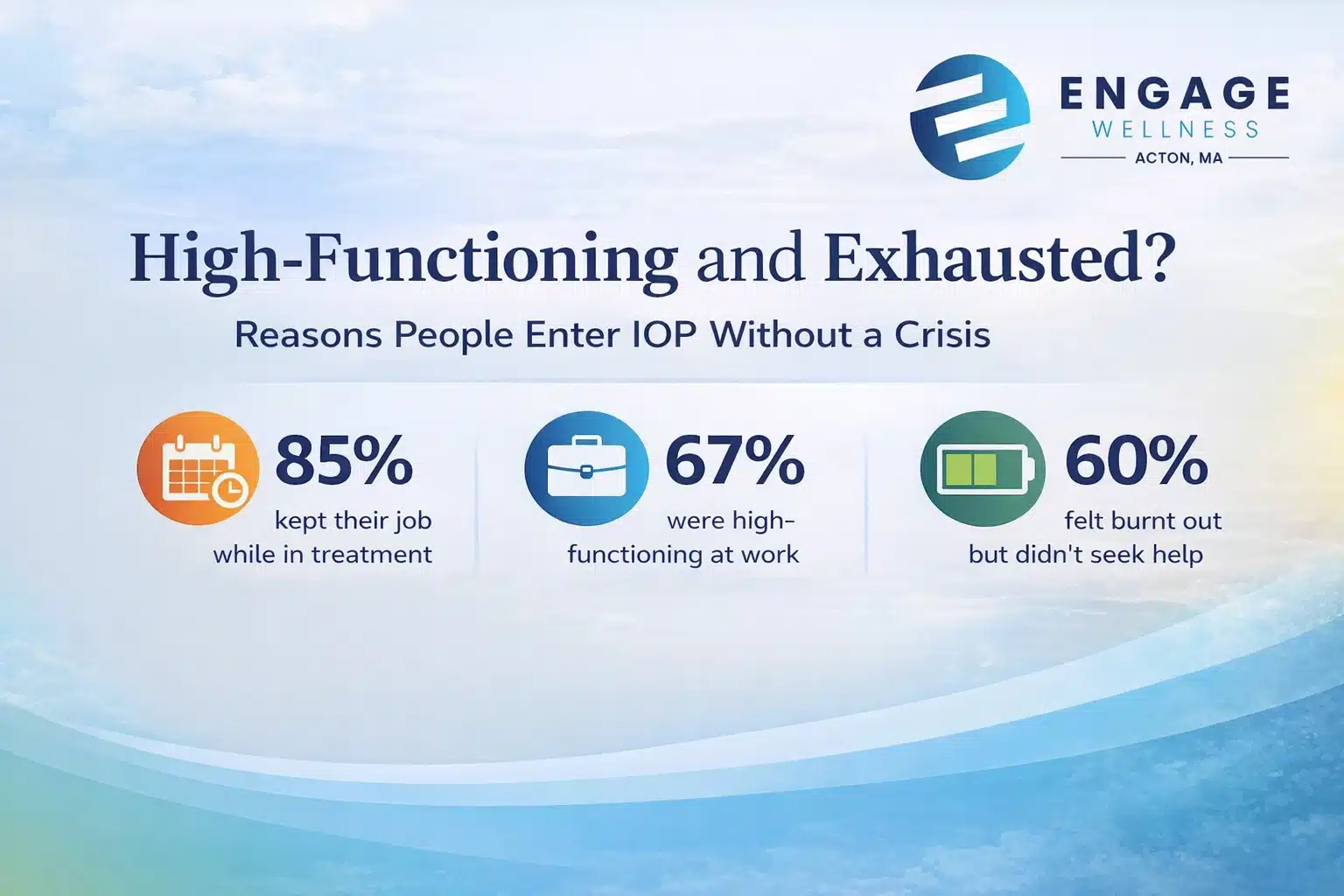
I assumed group therapy wouldn’t apply to me.
I planned to stay polite, measured, and mostly quiet.
That worked until I heard people who sounded exactly like me.
Professionals. Parents. High achievers. People who looked composed and quietly exhausted. People who were good at surviving but bad at stopping.
Listening to them felt unsettling—like hearing thoughts I’d never said out loud spoken by someone else.
That’s when the lie cracked: I’m not the exception.
And if this pattern existed outside me, maybe it could change inside me too.
This surprised me the most.
You don’t disappear into treatment.
You go home. You work. You deal with stress in real time.
That’s what makes it effective.
You talk about boundaries in session—and then try to set one that same night. You discuss emotional avoidance—and then notice how quickly you reach for distraction.
IOP doesn’t protect you from life.
It teaches you how to stay present inside it.
Being high-functioning meant control was how I survived.
I controlled schedules. Emotions. Conversations. Outcomes.
Even the story I told myself about who I was.
In an intensive outpatient program, control isn’t stripped away. It’s questioned.
What happens if you don’t optimize everything?
What happens if you admit uncertainty?
What happens if you stop performing competence?
Those questions felt dangerous because control had kept me upright. But it had also kept me disconnected.
Letting go didn’t make me reckless.
It made me human again.
Before treatment, my narrative sounded clean.
“I’m just busy.”
“I handle stress well.”
“I don’t really slow down.”
In IOP, the story shifted.
“I don’t know how to rest.”
“I avoid stillness.”
“I’m afraid of what comes up when I stop managing.”
That shift wasn’t dramatic. It was quiet—and deeply unsettling.
Like realizing you’ve been living on autopilot and suddenly feeling the controls again.
This was the hardest truth.
I was present physically but absent emotionally. Conversations felt transactional. Success felt oddly empty. Rest felt suspicious.
An intensive outpatient program gave language to something I’d felt but never named: emotional disconnection isn’t a personality trait. It’s a symptom.
And symptoms respond to care.
That realization alone changed how I viewed recovery.
Group spaces revealed how common this experience was.
I remember someone from Quincy, Massachusetts describing how they were praised for reliability while privately wondering why nothing felt satisfying anymore.
Another person from Medford, Massachusetts talked about being successful on paper but constantly anxious about slowing down—afraid that if they stopped managing, everything would collapse.
Listening to them felt like looking ahead in time.
IOP didn’t just show me where I was.
It showed me where I could end up if nothing changed.
I didn’t leave transformed overnight.
Progress looked like:
It was subtle. Sometimes uncomfortable. Often humbling.
But it was real.
Recovery didn’t arrive with fireworks.
It arrived with presence.
This is the sentence I wish someone had told me earlier:
You don’t need to fall apart to justify help.
An intensive outpatient program isn’t only for people in visible crisis. It’s for people who are quietly carrying too much, too well, for too long.
If you’re functioning but exhausted, capable but disconnected, composed but numb—this level of care meets you where you actually are.
Not where things look bad enough.
If you’re “fine” on paper but quietly struggling underneath, there is a way to get support without dismantling your life.
Call (978) 699-9786 to learn more about how our Intensive Outpatient Program in Massachusetts supports people who look okay—and want to feel okay too.
You don’t need proof that things are bad.
You just need permission to want them better.
No. Many people in IOP are high-functioning individuals addressing early-stage substance use, emotional burnout, or patterns that haven’t exploded—but are unsustainable.
Yes. IOP is designed to fit around real-life responsibilities. Most participants continue working or attending school.
You don’t need a label to seek support. Treatment focuses on impact, not identity.
Participation is encouraged, not forced. Many people start quietly and engage more as trust builds.
Often, yes. High-functioning individuals benefit from the structure, reflection, and accountability without stepping away from daily life.
Uncertainty is allowed. IOP isn’t about certainty—it’s about exploration with support.


© 2026 Engage Wellness. All Rights Reserved. Proudly Treating Drug & Alcohol Addiction in Massachusetts | Sitemap | Privacy Policy