


You already know your drinking isn’t sustainable.
That’s not the debate anymore.
The debate is quieter than that.
More private.
It sounds like:
What exactly am I signing up for?
Is this going to flip my whole life upside down?
Am I about to lose control of everything?
If you’ve been scrolling through pages about Alcohol treatment and feeling your chest tighten, that makes sense.
You’re not afraid of help.
You’re afraid of what help might mean.
Let’s slow this down.
It Is Support. It Is Not A Punishment
Many first-time treatment seekers brace themselves for shame.
They expect a lecture. A confrontation. A dramatic moment where someone lists every mistake they’ve made.
That’s not what happens here.
You’re not walking into a courtroom. You’re walking into a conversation.
Treatment is not about proving how bad things are. It’s about stabilizing what feels unstable.
If you’ve been hiding how much you drink—at work, with friends, maybe even with family—you’re probably already carrying enough judgment internally.
You don’t need more of it.
You need space to breathe.
It Is Structure. It Is Not Losing Your Freedom
One of the biggest misconceptions is that starting care means giving up your autonomy.
It doesn’t.
Structure isn’t control. It’s rhythm.
When alcohol becomes the nightly off-switch, your nervous system lives in a constant swing—stress all day, sedation at night, anxiety the next morning.
Structured daytime care or multi-day weekly treatment creates a steadier pattern. Not to box you in. To help you stabilize.
Stability doesn’t shrink your life.
It expands your capacity to live it without constant negotiation.
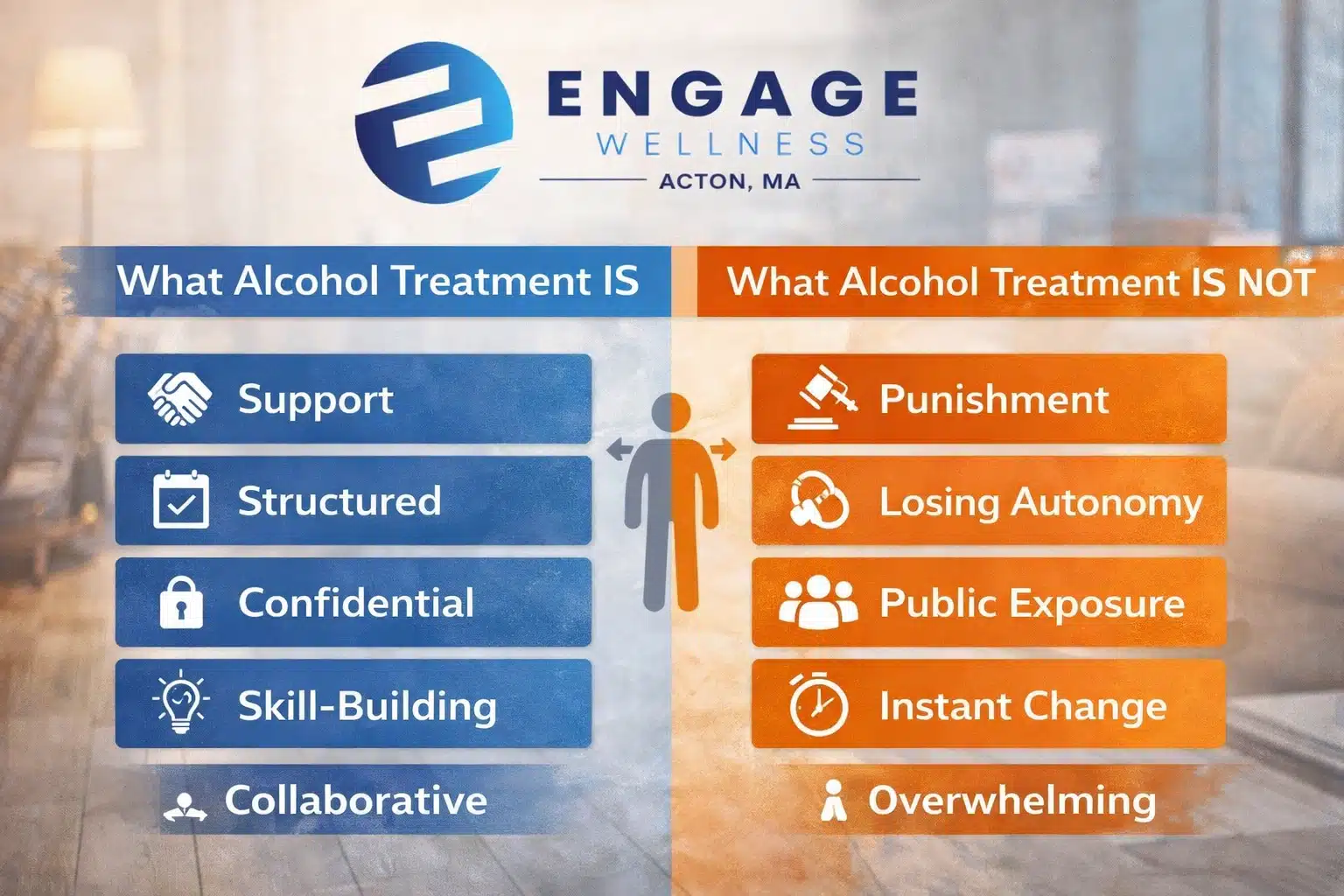
It Is Confidential. It Is Not Public Exposure
Privacy is a real concern.
You might be thinking:
Who will know?
Will this follow me professionally?
Will this change how people see me?
Treatment is confidential. What you share stays protected.
Many of the people who seek care are professionals. Parents. Business owners. Community members in places like Lowell, Massachusetts and Lynn, Massachusetts who are quietly managing responsibilities while privately struggling.
Seeking help doesn’t label you.
It strengthens you.
It Is Skill-Building. It Is Not Just Talking About Feelings
Yes, there will be conversations.
But there will also be tools.
How to manage cravings without white-knuckling.
How to regulate anxiety without reaching for a drink.
How to sleep without sedation.
How to handle social events sober.
How to address when mental health and substance use collide.
This isn’t endless emotional excavation.
It’s learning how to live differently.
And practically.
It Is Adjustment. It Is Not Instant Transformation
Let’s be honest.
The first few weeks can feel strange.
Your body recalibrates.
Your routines shift.
Your evenings look different.
You may feel more emotionally exposed before you feel steady.
That doesn’t mean something is wrong.
It means your nervous system is healing.
Think of it like taking your foot off the gas after driving too fast for too long. The slowdown can feel uncomfortable.
But it’s safer.
And sustainable.
It Is Collaborative. It Is Not Something Done To You
You are not surrendering control.
You are entering a partnership.
If something doesn’t feel right, we talk about it. If your needs shift, your plan can shift.
Care should feel like a conversation—not a command.
You’re not being managed.
You’re being supported.
It Is A Beginning. It Is Not The End Of Who You Are
One quiet fear many first-time treatment seekers carry:
If I do this, I become “someone in treatment.”
But here’s the truth:
You are not your drinking pattern.
You are not your lowest moment.
You are not a label.
Beginning alcohol treatment doesn’t erase your identity.
It gives you a chance to live it more fully.
If you’re exploring what care in Recovery could look like without dismantling your life, you can review options on our care in Recovery page.
You don’t need to map out the next five years.
You just need to consider the next step.
What It Often Feels Like—Before And After
Before starting:
- You minimize.
- You negotiate with yourself.
- You promise to cut back.
- You feel relief when you drink.
- You feel regret the next morning.
After engaging in care:
- The mental tug-of-war quiets.
- Sleep improves.
- Anxiety stabilizes.
- Your decisions feel intentional, not reactive.
It’s not dramatic.
It’s steady.
And steady is powerful.
The Part No One Talks About
Many first-time treatment seekers aren’t dramatic.
They’re high-functioning. Responsible. Quietly overwhelmed.
They’ve been holding everything together so well that no one realizes how heavy it feels.
If you’re here, it probably means you’ve reached a point where “managing it” isn’t enough.
You don’t want a catastrophe.
You want clarity.
That’s not weakness.
That’s awareness.
But not starting doesn’t eliminate the risk of failure. It just delays the possibility of change.
Treatment isn’t about proving you’ll never struggle again.
It’s about giving yourself better tools when you do.
You don’t have to be fearless.
You don’t have to be certain.
You don’t have to wait until things get worse.
If you’re ready to have an honest conversation about what comes next, Call (978) 699-9786 to learn more about our Alcohol treatment in Middlesex County, Massachusetts.