
IOP
The Hard Part of Coming Back After You Walked Away

Written By
IOP
Written By
Sometimes people don’t plan to leave treatment.
It just happens.
One missed session turns into two. Then three. Life gets busy, emotions get heavy, or maybe drinking or substance use returned and made it feel too uncomfortable to walk back through the door.
The longer the silence lasts, the harder it can feel to return.
If that sounds familiar, you’re not alone—and you’re not stuck.
Many people pause treatment and later come back stronger. If you’re considering returning, exploring options like multi-day weekly treatment can help you reconnect with support while still managing everyday responsibilities.
But the real first step isn’t paperwork or scheduling.
It’s allowing yourself to believe that coming back is possible.
One of the biggest barriers to returning after ghosting treatment is shame.
You might think:
They probably think I quit.
I already wasted my chance.
They’ll be disappointed in me.
But recovery doesn’t work like a school attendance record.
People step away from treatment for many reasons. Work schedules change. Emotional topics feel overwhelming. Substance use returns. Life becomes chaotic.
Clinicians understand this better than most people realize.
When someone reaches back out after disappearing, the typical response isn’t frustration.
It’s relief.
Because it means the person is still trying.
And trying again matters more than getting everything right the first time.
The first step back is often much smaller than people imagine.
You don’t need a long explanation.
You don’t need to prepare a speech.
A short message is enough:
“Hi, I stopped attending for a while but I’d like to talk about coming back.”
Or even:
“I’m hoping to reconnect and see what my options are.”
That single message can reopen the conversation.
Recovery programs are used to hearing from people who paused treatment. Reaching out again isn’t unusual—it’s part of the process for many people.
Think of it like knocking on a door that was never really closed.
If you feel comfortable sharing, honesty can make returning easier.
Treatment teams aren’t looking for perfect explanations. They’re simply trying to understand what made things difficult so they can support you better.
Some common reasons people pause treatment include:
All of these experiences are common in recovery.
Sharing honestly allows your care team to adjust your plan so support feels more manageable.
Recovery isn’t about pretending things are fine.
It’s about finding ways to move forward when things aren’t.
Many people worry that returning means they’ll have to explain every missed session.
In reality, treatment teams usually focus on something much simpler:
Where you are now.
What matters most is not how long you were gone.
What matters is that you’re willing to reconnect today.
Recovery isn’t a straight line. It’s more like a winding path with pauses, detours, and restarts.
The moment you decide to come back becomes the new starting point.
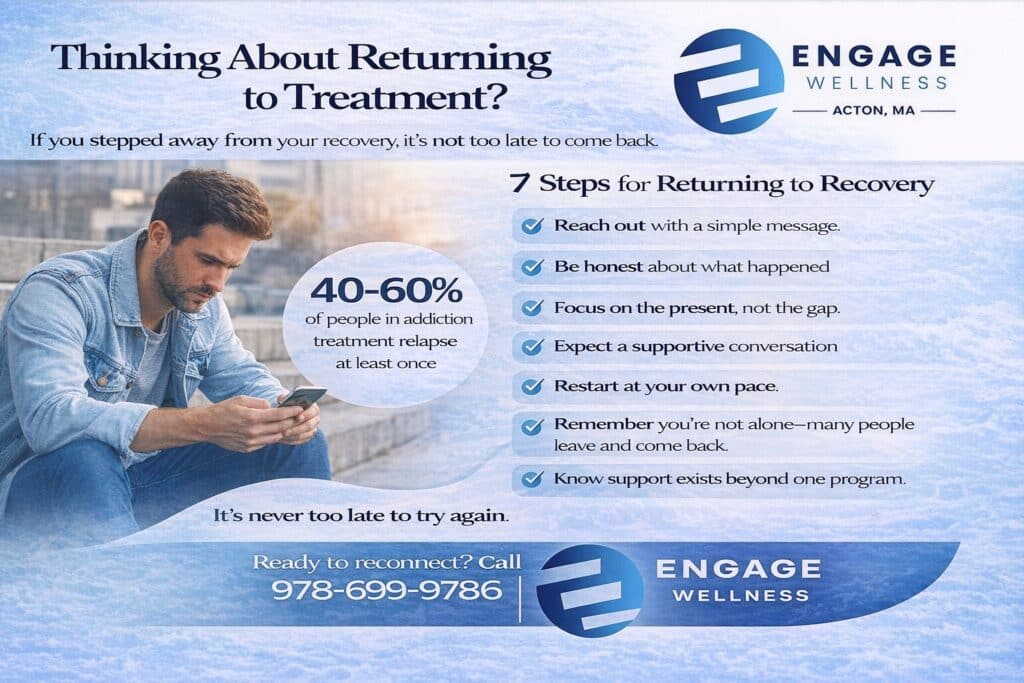
People often imagine returning to treatment will feel uncomfortable or awkward.
They picture judgment, lectures, or difficult conversations.
But recovery communities tend to understand how complicated the process can be.
Clinicians have worked with many individuals who left treatment temporarily and later came back ready to try again.
When someone reconnects, the conversation is usually straightforward:
How have you been doing?
What made things difficult before?
What kind of support would help right now?
The goal is not to make you feel guilty.
The goal is to help you stabilize and move forward.
Another common fear is that returning means you have to promise everything will go perfectly this time.
That’s not how recovery works.
People struggle. They have setbacks. They learn as they go.
Returning to treatment isn’t about proving you’ll never make mistakes again.
It’s about giving yourself another opportunity to build support.
Many people who pause treatment return with new insight about what they need.
Sometimes that insight becomes the key to stronger recovery.
If you feel embarrassed about stepping away, it might help to know how common this experience is.
Treatment programs regularly work with people who paused their care and later returned.
Some people step away for a few days.
Others come back after weeks or months.
Life is unpredictable, and recovery is rarely perfect.
But people who return after a pause often carry something valuable with them:
Perspective.
They understand more clearly why support matters and what they need moving forward.
If returning to your original treatment program feels difficult, it’s still possible to reconnect with support elsewhere.
Different programs offer different schedules, approaches, and environments.
Sometimes exploring a new option can make it easier to begin again.
You may also find resources offering support in Recovery and local treatment options that help guide the next step.
What matters most is not where you begin again.
It’s that you do.
Coming back after stepping away can feel uncomfortable.
It requires honesty. Humility. And the willingness to try again.
But it also shows something important.
Resilience.
Recovery doesn’t belong only to people who get everything right the first time.
It belongs to people who keep returning to the path—even after they wander away.
Sometimes the most powerful moment in recovery isn’t the first step.
It’s the step where you decide to come back.
It’s almost never too late to reconnect with support. Recovery is a process that allows room for restarts and second chances.
If you’re ready to take the first step back into support, help is available.
Call 978-699-9786 or visit our Intensive Outpatient Program services in to learn more about our Intensive Outpatient Program services in Westford, MA.
Yes. Many treatment programs regularly reconnect with people who paused their care. Reaching out again is common and usually welcomed.
Most clinicians understand that recovery involves setbacks and interruptions. Their focus is usually on helping you move forward rather than judging what happened.
You’re welcome to share as much or as little as you feel comfortable with. Some people explain their experience, while others simply ask about returning.
This is very common. Treatment teams are trained to support people through relapse and setbacks. Reaching out can help you reconnect with the support you need.
Not necessarily. Depending on your situation, your treatment team may help you resume where you left off or adjust your care plan to better fit your needs now.
Many people feel this way. But recovery communities often respond with understanding rather than judgment. Returning after a pause is more common than you might think.


© 2026 Engage Wellness. All Rights Reserved. Proudly Treating Drug & Alcohol Addiction in Massachusetts | Sitemap | Privacy Policy