


If you’ve been in recovery for years and something feels subtly off, you’re not imagining it. And you’re not doing anything wrong.
Many people who return to a Day treatment program aren’t in active crisis. They’re sober. They’re functioning. They’re doing what recovery once asked of them. But inside, the connection feels thinner. Less grounded. More mechanical.
From a clinical perspective, this isn’t failure. It’s a signal. Recovery sometimes needs recalibration—not because you’ve lost it, but because you’ve outgrown the version that once held you steady.
When Stability Exists but Meaning Feels Distant
Long-term alumni often struggle in silence during this phase.
Externally, life may look “fine.” Internally, there’s a growing sense of emotional distance. Recovery starts to feel like something you maintain instead of something you live.
Clinically, we see this as a re-anchoring moment. The behaviors are intact, but the emotional and psychological roots need attention again. A day treatment program offers the structure to explore that without demanding you dismantle the life you’ve built.
This phase is common. It’s also rarely talked about.
A Day Treatment Program Offers Support Without Starting Over
One of the biggest fears we hear from alumni is this: I don’t want to go backward.
Day treatment isn’t about restarting your recovery. It’s about reinforcing it at a deeper level.
This level of care provides:
- Daily therapeutic structure
- Clinical oversight
- Ongoing connection to your real life outside treatment
You attend programming during the day and return home in the evening. That balance allows you to work on internal shifts while staying engaged with your responsibilities, relationships, and routines.
For many people seeking meaningful support in recovery, this model respects both where you’ve been and where you’re going.
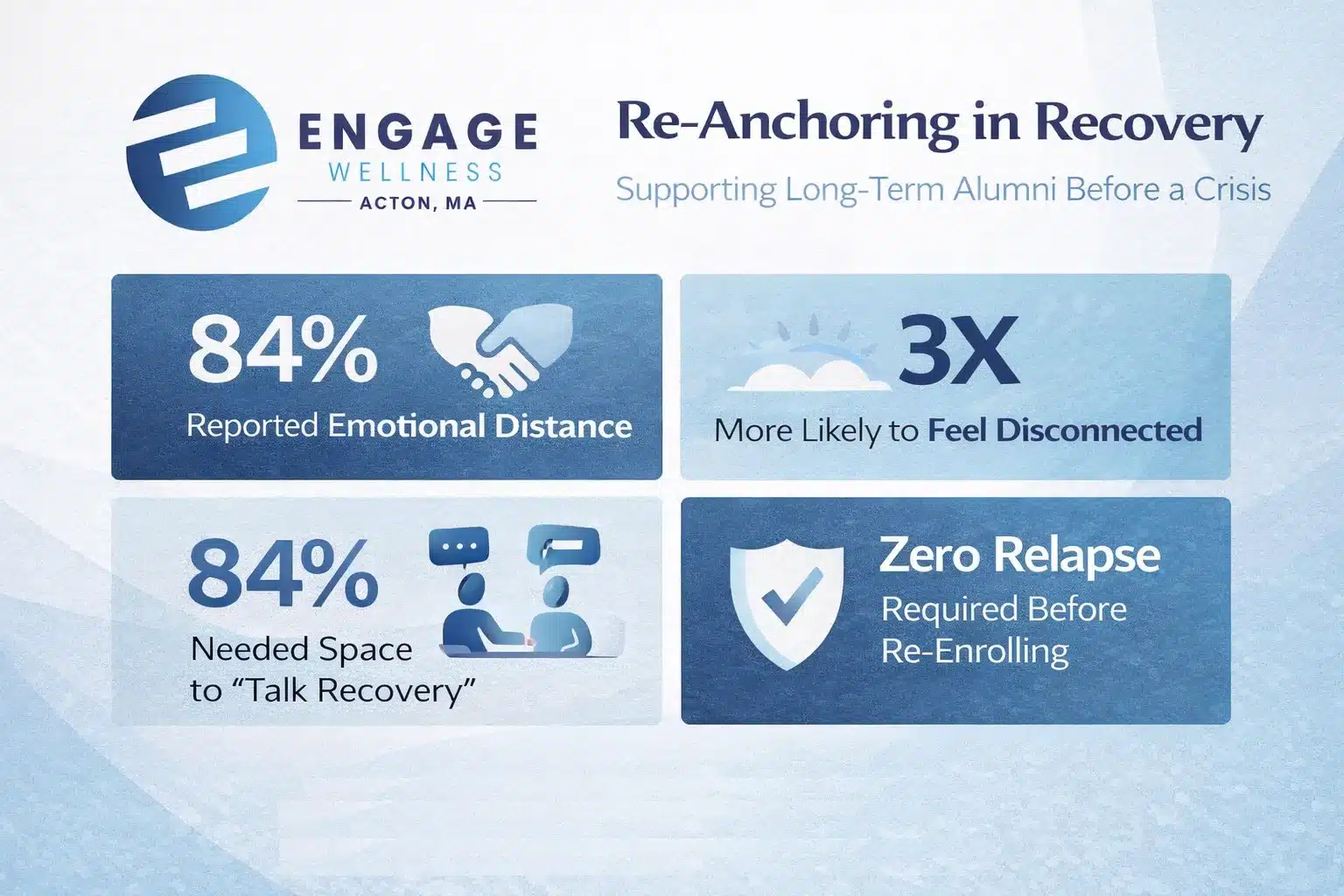
Re-Anchoring Focuses on What’s Shifted, Not What’s Broken
From a clinician’s point of view, the most important work in long-term recovery often happens quietly.
In a day treatment program, the focus shifts from crisis management to honest self-examination:
- Where did your emotional growth stall?
- What coping strategies no longer fit your current life?
- Which parts of yourself have you been bypassing to stay “okay”?
These questions don’t come from judgment. They come from respect for how far you’ve already come.
Re-anchoring isn’t about fixing damage. It’s about reconnecting to purpose.
Group Therapy Restores Connection Without Performance
One of the hardest parts of long-term recovery is the pressure to appear stable.
Group therapy within a day treatment program removes that expectation. You’re surrounded by people who understand the strange discomfort of struggling after you’re supposed to be past that stage.
Clinically, this matters. Disconnection fuels stagnation. Shared honesty restores movement.
Group spaces allow you to:
- Speak without needing to explain your history
- Hear reflections that mirror your own experience
- Rebuild trust in shared recovery spaces
Sometimes the most powerful moment isn’t insight—it’s recognition.
Individual Therapy Helps You Update Your Recovery
What worked five years ago may not work now.
Individual therapy in a day treatment program helps you revisit your recovery with fresh eyes. Not to dismantle it—but to update it.
This work often includes:
- Identifying emotional blind spots
- Addressing burnout or emotional flattening
- Exploring identity beyond survival mode
- Re-aligning values with current life demands
Clinically, this is not regression. It’s maturation. Recovery grows as you do.
Skills Work Becomes Refinement, Not Repetition
Long-term alumni don’t need basic tools. They need refined ones.
Skills-based sessions in a day treatment program often focus on:
- Navigating complex emotional states
- Managing success, stress, and responsibility
- Responding instead of reacting
- Reconnecting emotional awareness to daily decisions
Think of it less as relearning recovery and more as recalibrating how you apply it.
This kind of work restores agency—not by adding rules, but by restoring choice.
Re-Anchoring Often Looks Subtle From the Outside
From the outside, this phase of care may not look dramatic.
There may be no obvious transformation. No big announcement. No visible crisis resolved.
Instead, progress shows up quietly:
- You feel present again
- You stop going through the motions
- You remember why recovery mattered to you
Clinically, these shifts are profound. Even when no one else sees them yet.
You Don’t Have to Wait for Relapse to Ask for Support
One of the most important things we tell alumni is this: you don’t need to justify support by falling apart.
A day treatment program exists for people who notice early signs of disconnection and choose to respond instead of waiting.
We often work with individuals from Framingham, Massachusetts who recognize that recovery feels distant and want to re-engage before that distance becomes dangerous.
We also support alumni from Lynn, Massachusetts who are sober, functioning, and quietly exhausted from carrying recovery alone.
Needing support at this stage isn’t weakness. It’s awareness.
Recovery Is a Relationship, Not a Finish Line
Clinically, we often describe recovery as a relationship rather than a destination.
Sometimes it feels close. Sometimes neglected. Sometimes it needs honest conversation and renewed commitment.
A day treatment program offers space to sit back down with that relationship—not in crisis, but with intention.
You don’t have to start over. You just have to reconnect.
Taking the Next Step With Clarity
If you’ve been sober for a long time but feel disconnected, flattened, or quietly drifting, you don’t have to navigate that alone.
Call (978) 699-9786 to learn more about how our Day treatment program in Middlesex County, Massachusetts helps long-term alumni re-anchor to their recovery with depth, honesty, and respect.
Sometimes recovery doesn’t need more effort.
It needs more truth.