
Alcohol Treatment
Why Returning to Alcohol Treatment Didn’t Mean I Failed Recovery

Written By
Alcohol Treatment
Written By
I used to think relapse meant I blew it.
That everything I built—90 days of alcohol-free living, showing up for my kids again, laughing without liquid courage—was gone the moment I picked up. And for a while, that shame kept me quiet. Kept me stuck. But walking back into alcohol treatment didn’t mean I failed. It meant I was still in the fight.
Let me tell you what it really meant—and why coming back might be the strongest thing you do.
My first time in treatment, I was nervous, compliant, and quietly convinced that if I just “did recovery right,” I’d never drink again.
I thought recovery was a checklist. Stay 90 days sober? Check. Do the groups? Check. Say the affirmations even when I didn’t feel them? Check. And when I relapsed, it felt like I’d just torn up the whole list.
But coming back helped me see something deeper: I didn’t lose what I learned. The tools I picked up were still there. The understanding of my triggers, the memories of hard-won days—I hadn’t unlearned any of it. What changed was the lens. Relapsing didn’t mean I didn’t care. It meant I needed more support—and a new strategy.
One of the counselors said to me, “You’re not starting from scratch. You’re starting from experience.”
That hit me.
This wasn’t square one—it was mile marker ninety-one. I walked back in with more self-awareness. I knew what group settings helped me speak and which ones made me shut down. I knew when I was isolating versus when I just needed quiet. And most of all, I knew how fast shame could grow in silence.
Returning meant I could skip the mask I wore the first time around and just get real. It wasn’t easier—but it was more honest. And that mattered.
If you’re scared of how people will look at you when you come back, you’re not alone.
I pictured judgment. Disappointment. Maybe even someone pulling up my attendance record and sighing. What I got was: “We’re really glad you’re here.”
There was no lecture. No shaming. Just people—staff and peers—who understood that relapse doesn’t cancel your worth. If anything, it reaffirms your humanness. The people at Engage Wellness got that. They didn’t treat me like a failure. They treated me like someone still healing.
Nobody warns you how much grief can come with relapse.
I grieved the time I lost. The trust I’d started to rebuild. The quiet pride I had in myself. And if I’m honest, I grieved the version of me who believed I might be done with alcohol for good. That grief nearly swallowed me—until someone reminded me that grief is part of growth.
In treatment, we talked about forgiveness. Not the fluffy, one-and-done kind, but the real work of forgiving yourself for slipping without making that slip your identity. I didn’t erase what I’d done—I accepted it, felt it, and chose to keep moving.
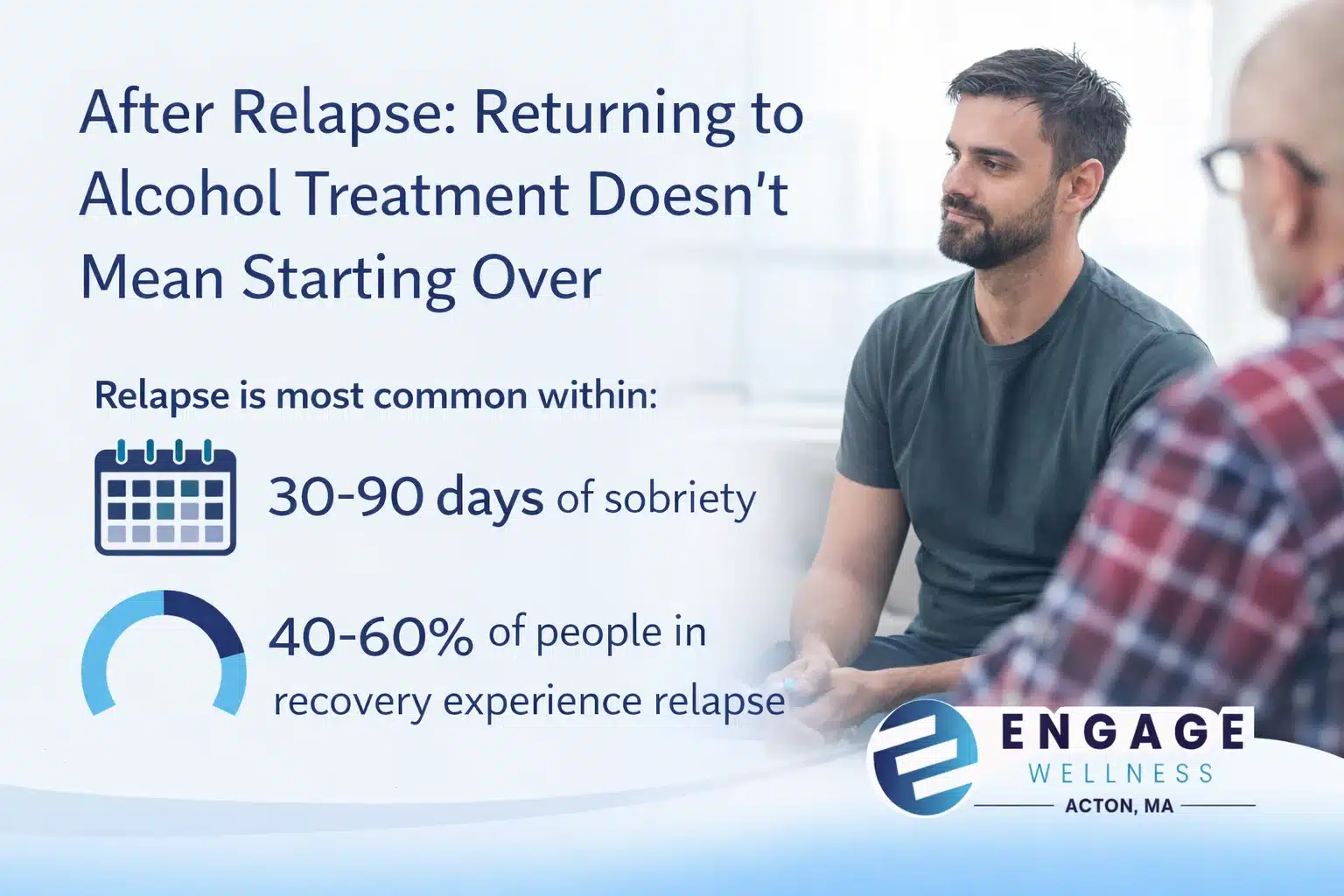
You wouldn’t know it from the highlight reels, but relapse is common. Quiet, painful, and common.
We don’t talk about it enough because it feels like failure. But relapse, especially after a few months sober, often shows up in the margins. When you’re tired. Lonely. Overconfident. Or just emotionally raw from doing the work.
Coming back doesn’t mean you failed—it means you noticed. You noticed that something wasn’t working. That’s not weakness. That’s awareness. And awareness is one of the most powerful tools in recovery.
This time around, I wasn’t afraid to speak up in group.
I didn’t pretend I was “fine” when I wasn’t. I let people in. I shared the part of my story that scared me most—how easy it was to slip back into drinking and how much I hated myself for it. And by naming that out loud, the shame started to loosen.
I also got clearer about my boundaries. I stopped trying to be the perfect alum. I let myself just be someone trying again. That was enough.
If you’re out there thinking, “They probably don’t want me back,” hear this:
You don’t need to qualify to get help again. You don’t need to prove your worth or explain your relapse in perfect words. If you’re even considering returning to treatment, that means part of you still believes change is possible. That part deserves support—not silence.
Programs like Engage Wellness are built to help people who are still trying. Who fall down, get up, and maybe fall again. Whether you’ve been gone 30 days or 300, you’re not banned from healing.
You can always find help in recovery—especially in communities that understand relapse isn’t a moral failure. It’s a signal.
More than anything, it gave me clarity.
I didn’t walk out with every answer. But I walked out with more honesty, more tools, and more respect for how deeply personal this process is. It’s not about counting days. It’s about reclaiming your life one decision at a time.
Some days are still hard. But now, when they are, I don’t disappear. I speak. I ask for help. I tell the truth faster.
And that’s not failure. That’s recovery.
Yes. Many people experience relapse after 30, 60, or 90 days. It’s not a sign you didn’t care or weren’t serious. It usually means you hit a stress point or trigger your current support system wasn’t equipped to hold. Returning to treatment can help you reinforce your recovery, not restart it.
No. Centers like Engage Wellness are staffed by people who understand the full spectrum of recovery. Many staff members are in recovery themselves. Judging you isn’t the point—helping you is.
Shame is real—and heavy. But it often shrinks in safe spaces. By speaking it out loud in a group, or even just to one counselor, you take away its power. You don’t have to carry it alone.
Absolutely. There’s no waiting period for needing support. Whether it’s been weeks or months, if you feel the pull toward returning to care, that’s a valid need.
You come in with lived experience. That changes everything. You may receive a personalized treatment plan that accounts for what worked (or didn’t) last time. You’ll also often find it easier to connect with others because you’ve already walked part of the path.
Relapse didn’t end my story. Returning to alcohol treatment gave me a new chapter—one written with more honesty, more tools, and a lot more self-respect.
Call (978) 699-9786 to learn more about our Alcohol treatment services in Middlesex county, MA.


© 2025 Engage Wellness. All Rights Reserved. Proudly Treating Drug & Alcohol Addiction in Massachusetts | SEO by DIGITECH | Sitemap | Privacy Policy