
Day Treatment
How Day Treatment Helps Break the Relapse Cycle: A Clinician’s Perspective for Parents

Written By
Day Treatment
Written By
If your 20-something child has relapsed again, you’re probably somewhere between heartbreak and numbness.
You’ve already done so much—therapy, maybe a detox or rehab stay, endless late-night conversations, promises, curfews, contracts. You’ve tried hope, and you’ve tried tough love. And now, here you are again, wondering: What do we do this time?
We hear this question every day.
At Engage Wellness in Acton, MA, our day treatment program is often the next step for families stuck in the loop of relapse. And not just because it’s “more treatment”—but because it’s different treatment. More consistent. More structured. More emotionally intelligent. It gives young adults the kind of support most of them haven’t actually experienced yet—and it gives parents something even more rare in moments like this: hope.
Let’s walk through why relapse happens, what day treatment actually offers, and how it can change the pattern—not just patch it.
When relapse happens, it often feels like erasure. All the work, all the progress, all the promises—gone. But relapse isn’t the end of a story. It’s a communication from the nervous system that something deeper still needs care.
Sometimes, relapse means:
What matters now isn’t tallying how many times they’ve “failed.” What matters is asking: What haven’t we tried yet?
That’s where day treatment comes in.
In most relapse scenarios, things fall apart gradually: skipped therapy appointments, missed meds, isolating from friends, lying, disappearing, using “just once,” then again, and again.
Day treatment creates a hard stop—a pause button that helps stabilize the situation before it spins completely out of control.
Unlike inpatient rehab, your child doesn’t need to move out of their life. They attend treatment 5–6 hours a day, 5 days a week, and go home each evening. This format provides a strong container for recovery while keeping them connected to the real world.
It’s intensive enough to make a difference. Flexible enough to fit into life.
And it offers what’s often been missing: daily, continuous engagement with care that holds them accountable without shaming them.
By the time a young adult relapses, they’re often emotionally raw. They may be ashamed of disappointing people. Defensive. Disconnected. Unmotivated. Sometimes they don’t want to talk at all.
Day treatment doesn’t require emotional performance. It simply requires presence.
Our clinicians understand how to work with young adults who:
They don’t need to be enthusiastic. They don’t need to be “all in.” They just need to show up. And we help from there.
Here’s something many parents have noticed: their young adult does okay in inpatient treatment. But when they come home? Things unravel.
Why?
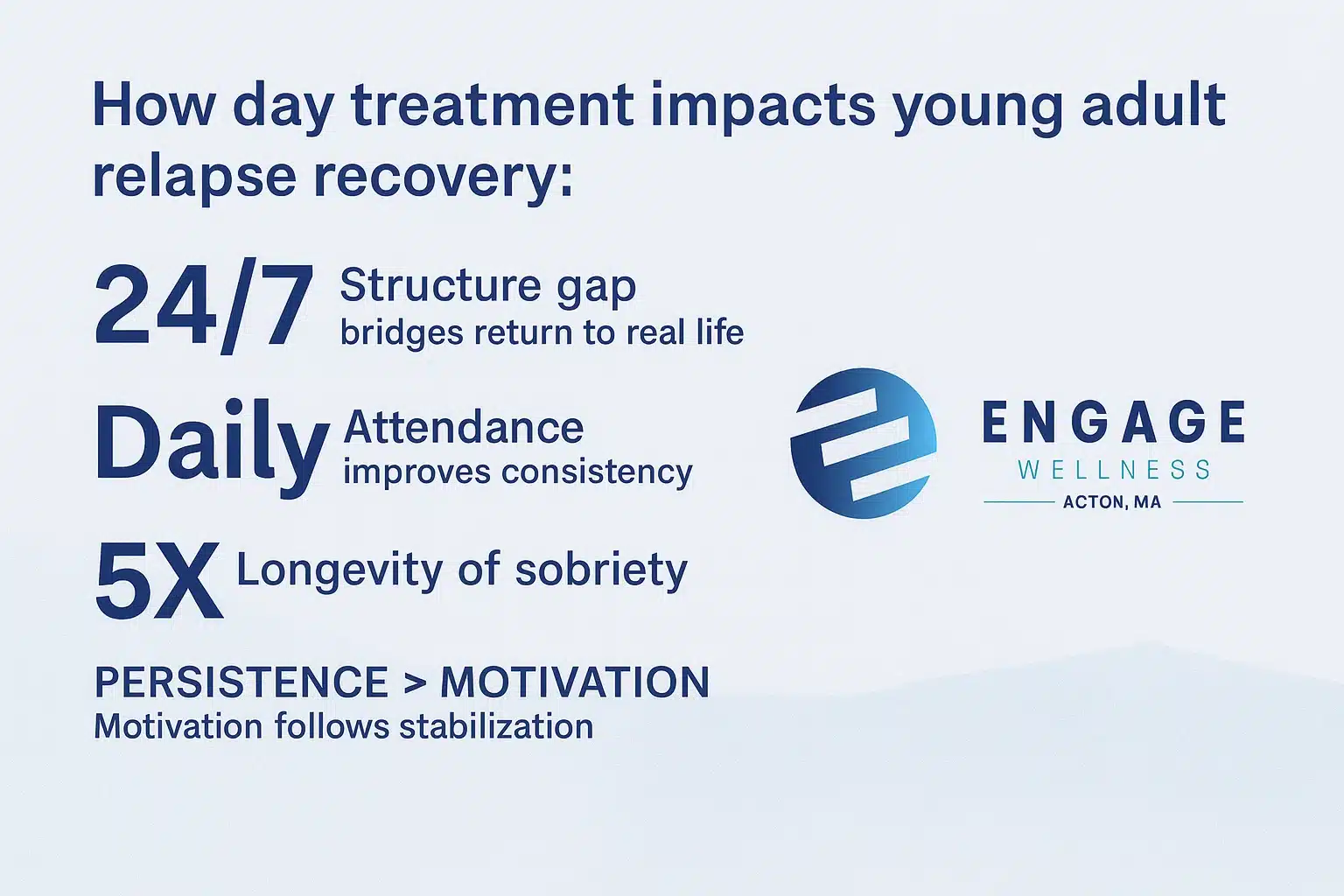
Because 24/7 care creates a vacuum—one that real life rushes to fill the moment they return.
Day treatment bridges that gap.
Instead of going from “all day structure” to “total freedom,” they enter a rhythm of daily support that helps them:
This kind of transition lowers relapse risk and gives them a chance to build confidence before they’re on their own again.
One of the biggest mistakes families and even some programs make is focusing only on the alcohol, the weed, the pills.
Substances are often just the surface symptom.
Our clinical team looks at what’s underneath:
We use trauma-informed assessments and build individualized care plans around what’s really going on—not just what’s showing up on the outside.
That means therapy isn’t generic. It’s targeted. Specific. Rooted in why the behavior exists.
If your child has relapsed, you’ve probably been stuck between extremes: feeling shut out or feeling totally responsible. Neither feels right. Both are exhausting.
Day treatment gives you a third option: informed connection.
With your child’s permission, we offer:
You don’t have to monitor everything. You don’t have to be the safety net, the motivator, the emotional sponge. We hold that now. And we help you reclaim the role of parent, not protector or parole officer.
Sometimes the fourth try is the one that works. Or the fifth. Not because your child suddenly gets stronger—but because the support system finally fits.
We’ve seen day treatment be the point where:
No two recoveries are the same. But when a young adult relapses and then enters structured, daily treatment, something shifts: they stop surviving and start building.
Yes. In many cases, relapse happens because the support after treatment wasn’t enough. Day treatment builds a bridge between crisis care and everyday life.
Most programs run for 2–4 weeks, depending on clinical need. Some clients step down to IOP (intensive outpatient) afterward for continued support.
Motivation often comes after stabilization—not before. They don’t need to feel ready to change. They just need to show up.
Yes. Clients live at home and attend treatment during the day. We’ll help you decide if that’s appropriate, or if a different setting would be safer.
With their consent, yes. We encourage healthy family involvement and offer guidance on how to support them without enabling.
It’s easy to feel like you’ve failed. Like if you’d just done something differently, they wouldn’t be using again. But addiction, relapse, and recovery are more complex than that. They don’t reflect your worth—or theirs.
Your child is still here. That means there’s still possibility.
Day treatment isn’t a magic wand. But it is a real, grounded, clinical next step that can help break the cycle. Not by forcing compliance. But by rebuilding connection, structure, and stability—one day at a time.
Let’s talk about what’s next.
Call (978) 699-9786 or visit our Day Treatment page to explore how we can support your child in Acton, MA. You don’t have to walk this alone—and neither do they.



© 2025 Engage Wellness. All Rights Reserved. Proudly Treating Drug & Alcohol Addiction in Massachusetts | SEO by DIGITECH | Sitemap | Privacy Policy