
IOP
How an Intensive Outpatient Program Helps After You Gave Up on Yourself

Written By
IOP
Written By
If you stopped going to treatment, ignored the messages, or told yourself you’d figure it out later, this isn’t a reminder of what you did wrong.
It’s a map back.
Many people who return to an Intensive outpatient program aren’t coming back because they feel hopeful. They’re coming back because they feel tired—tired of pretending they’re okay, tired of starting over alone, tired of carrying something that keeps getting heavier.
From a clinical standpoint, ghosting treatment is not a moral failure. It’s a coping strategy that stopped working.
Let’s say the quiet part out loud.
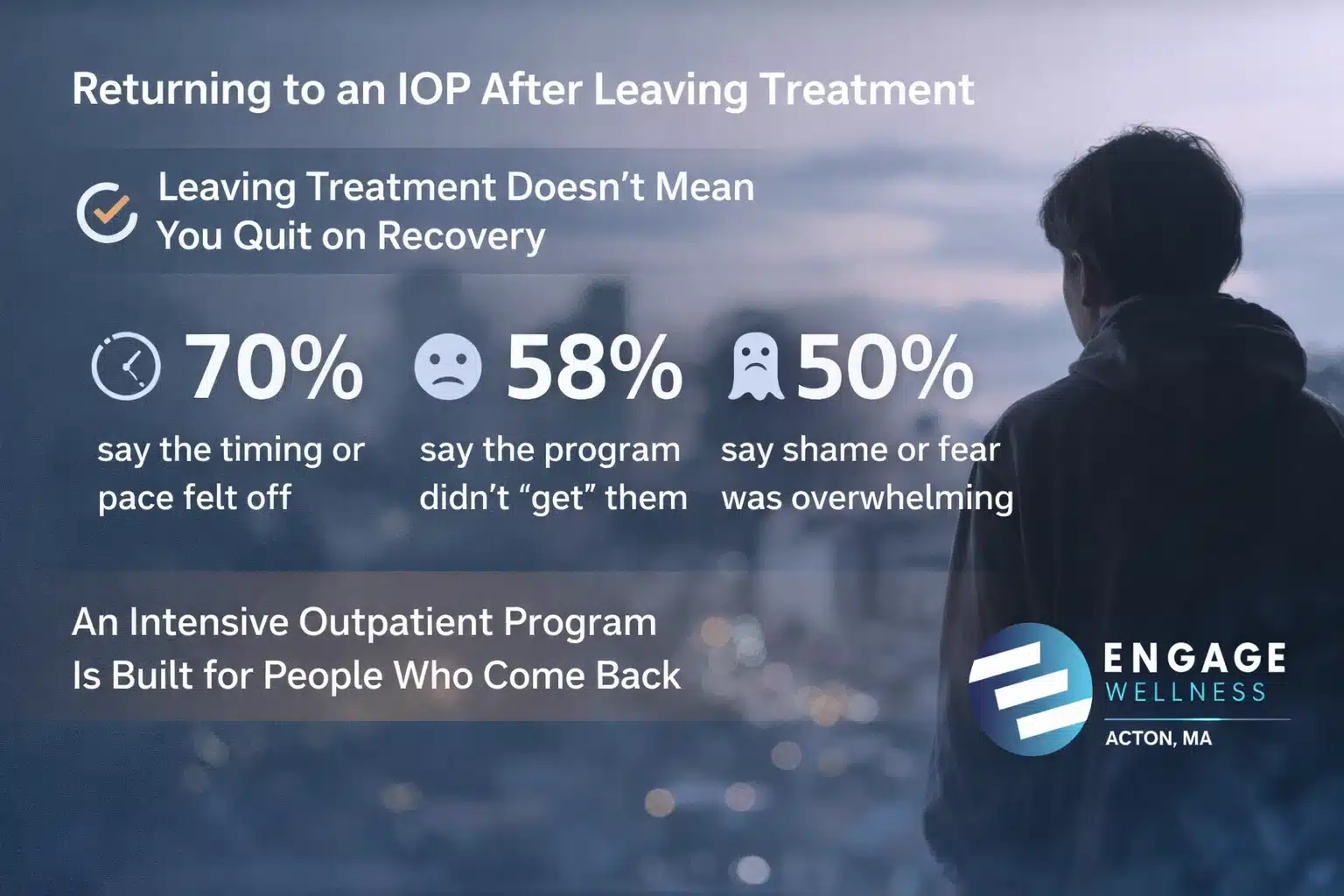
Most people who leave an intensive outpatient program don’t do it because they don’t care. They leave because the program collided with real life, real emotions, or real fear.
Clinically, people step away when:
None of that means recovery failed. It means the structure didn’t match the moment.
An IOP is not a test of willpower. It’s a tool. And tools sometimes need to be picked up again differently.
One of the biggest misconceptions about IOP is that it’s linear.
It’s not.
Clinically, intensive outpatient programs are designed with flexibility because recovery isn’t neat. People leave. People return. People circle back with more information about themselves than they had the first time.
You don’t have to explain why you disappeared.
You don’t have to justify needing help again.
You don’t have to pretend you’re more confident than you are.
Coming back isn’t a reset. It’s a continuation—with context.
Before re-entering an intensive outpatient program, the most important step isn’t commitment. It’s honesty.
From a clinician’s perspective, the question isn’t why did you quit?
It’s what made staying impossible at the time?
That might include:
IOP works best when these things are named, not buried. The goal isn’t to toughen up. It’s to adjust the care.
This is especially important for people exploring treatment options in recovery that have to fit alongside work, family, or school.
A common fear after dropout is that returning means being watched more closely or judged more harshly.
Clinically, the opposite is usually true.
Returning clients often receive more individualized attention because they bring clarity. They know what overwhelmed them. They know what they avoided. That insight helps shape care.
An intensive outpatient program is not about catching you slipping. It’s about helping you stay connected long enough for change to happen.
You’re not being monitored. You’re being supported.
If group therapy was part of why you left, you’re not alone.
The first time through, many people feel pressure to say the right things, show progress, or appear motivated. That pressure can make honesty feel dangerous.
When people return to IOP, group therapy often changes because the performance drops.
Clinically, this matters. Real work happens when:
Sometimes the bravest sentence in group is, “I left because I was scared.”
That sentence opens doors.
After ghosting treatment, trust—especially in providers—can feel fragile.
Individual therapy within an intensive outpatient program gives space to:
From a clinician’s point of view, returning clients often do deeper work faster—not because they’re stronger, but because they’re more honest.
You don’t have to believe in the process yet. You just have to stay in the room.
One mistake people make when returning to IOP is expecting a dramatic shift.
Clinically, progress after dropout is subtle.
It often looks like:
Recovery doesn’t restart with confidence. It restarts with consistency.
Like plugging something back in—not because it’s broken, but because it ran out.
Many people believe they’re uniquely bad at treatment.
They’re not.
We regularly work with individuals from Worcester, Massachusetts who stepped away from care, tried to handle things alone, and realized isolation wasn’t the solution.
We also support people from Somerville, Massachusetts who ghosted treatment not because they didn’t want help—but because they didn’t know how to ask for it without feeling exposed.
Returning doesn’t make you unreliable. It makes you self-aware.
An intensive outpatient program isn’t about proving you want recovery badly enough.
It’s about creating conditions where staying feels possible.
That means:
Clinically, relapse prevention isn’t about motivation. It’s about connection.
And connection can be rebuilt—even after you walked away.
Yes. Leaving treatment is common, and returning is welcomed. It provides valuable insight into what support you need now.
No. Clinicians are trained to see dropout as information, not failure.
Not necessarily. Treatment plans are adjusted based on your experience and current needs.
That fear is normal. Naming it early actually helps prevent it.
For many people, yes. IOP offers structured support while allowing you to stay connected to daily life.
You don’t need to. The program holds consistency until you can.
If you left treatment and told yourself you were done trying, you don’t have to carry that alone anymore.
Call (978) 699-9786 to learn more about how our Intensive Outpatient Program in Massachusetts supports people who left—and came back—without shame.
You didn’t give up because you didn’t care.
You gave up because it was hard.
Coming back is how you stop doing it alone.


© 2025 Engage Wellness. All Rights Reserved. Proudly Treating Drug & Alcohol Addiction in Massachusetts | SEO by DIGITECH | Sitemap | Privacy Policy