
Alcohol Treatment
If You’re Reading This, You’re Ready: How Alcohol Treatment Really Works

Written By
Alcohol Treatment
Written By
There’s a moment before the moment.
Before the call. Before the intake. Before the first group or the first “I think I need help.” There’s this quiet pause where something inside you says, “I can’t keep doing this.”
That moment doesn’t always feel brave. Sometimes it feels like failure. Sometimes it feels like fear. But if you’re here—reading this—you’re already in that moment.
And that means something.
It means you’re not numb anymore. It means part of you still believes in change. It means you’re ready—even if you don’t feel like it yet.
This blog won’t fix everything. But it will show you what alcohol treatment actually looks like—and why it’s more human, more flexible, and more possible than you might think.
Let’s get one thing out of the way: alcohol treatment is not about shame.
It’s not about lectures. It’s not about labeling you as broken or making you feel like your past choices define your future. At Engage Wellness, it’s about creating space—for clarity, for healing, for trying again.
Alcohol treatment means you don’t have to figure this out alone. You don’t have to white-knuckle your way through every day, hoping the urge passes. Treatment gives you structure. Support. A place to ask hard questions and get real answers.
And no—there’s no one-size-fits-all formula.
Some people want to stop drinking completely. Others just want to understand their relationship with alcohol. Some arrive sober. Others come in still using. All are welcome.
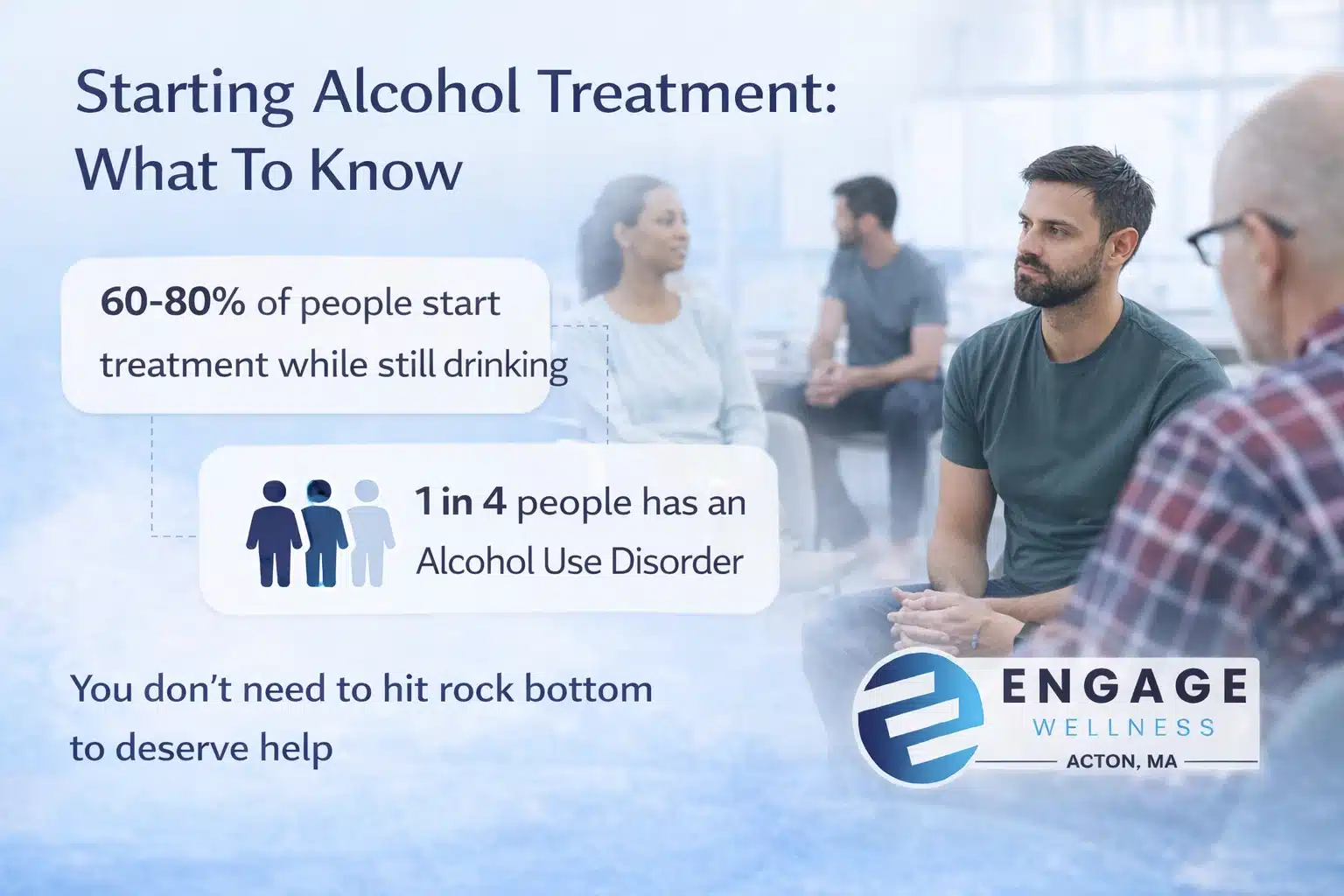
One of the most damaging myths about recovery is this: “You have to hit rock bottom first.”
Not true.
At Engage, we work with people who still have careers, relationships, goals, and lives that look good from the outside. But inside, things feel shaky. Maybe you’re hiding your drinking. Maybe you’ve tried to cut back and can’t. Maybe alcohol just feels too big and you don’t know what else to do.
You don’t need to wait for a crisis to ask for help. If you’re questioning whether alcohol is hurting you, that’s enough.
Getting support now means reclaiming your life before more damage is done. And yes, you’re allowed to want that.
The first step isn’t a test—it’s a conversation.
Whether you call, fill out a form, or talk to a friend who refers you, the process starts with listening. One of our team members will ask a few questions about what’s been going on. Not to judge—but to understand.
You don’t need perfect answers. You just need honesty.
From there, we’ll schedule an assessment—a one-on-one session where we’ll learn more about your mental health, your drinking patterns, your support system, and what kind of help feels doable for you.
Think of it like drawing a map together. You tell us where you’ve been, and we help chart a path toward where you want to go.
There’s no “standard script” here. Because there’s no standard story.
At Engage Wellness, your treatment plan is built around what works best for you. That might include:
You may start with 2–3 sessions a week. You may need more support, or less, as things unfold. The goal is to create something sustainable—not overwhelming.
And yes, you’ll be part of shaping that plan. We’ll never force you into something that doesn’t feel right.
If you’re feeling scared, awkward, or unsure—you’re not the only one.
Most people walk into treatment wondering if they even belong there. But what you’ll find is a community of people who get it. Many of our staff members are in recovery themselves. They remember what it felt like to make that first call, to sit in that first group, to say, “I think I need help.”
The truth is, treatment doesn’t “fix” you. It supports you. It holds you steady while you figure out what’s underneath the drinking—and how to meet those needs in healthier ways.
Even after you start, fear doesn’t vanish.
You might think, What if I can’t do this? What if it doesn’t work? What if I hate who I am without alcohol?
These fears are valid. But you don’t have to solve them all at once. Treatment gives you space to explore those fears without being consumed by them.
You don’t need to know exactly how you’ll get better. You just need to believe—on some level—that healing is worth a shot.
You may have already tried to quit or cut back on your own.
Maybe it worked for a while. Maybe you went weeks—or even months—without drinking. But it didn’t hold. Or it left you feeling more isolated than ever.
That’s where treatment comes in. Because willpower isn’t a recovery plan. Support is.
Here’s what treatment gives you that white-knuckling can’t:
Not just a sober life—but a better life.
A life where you wake up clear-headed. Where you trust yourself again. Where the shame doesn’t speak louder than the hope.
That kind of life is possible. And if you’re reading this? You’re already closer to it than you think.
No. Many people enter treatment while still drinking. The goal is to meet you where you are and support you from there.
That’s okay. We’ll work with you to clarify your goals—whether that’s moderation, sobriety, or something in between. You don’t need all the answers to begin.
Yes. Your privacy is protected under federal and state laws. What you share with us stays between you and your care team.
It depends on your needs. Some people engage in outpatient care for a few weeks. Others continue with therapy or support groups for months. Your timeline is your own.
You’re not alone. Many first-time clients carry deep shame and silence. Our staff is trained to create a safe space for you to speak, be heard, and never judged.
You don’t need to spiral. You don’t need to be “ready” in the way the world defines it.
You just need to act on the part of you that’s still whispering, “I want more than this.”
Call (978) 699-9786 to learn more about our Alcohol treatment services in Middlesex county, MA.
We’re ready when you are. And if you’re still not sure? That’s okay too. Stay curious. Keep asking. Keep hoping.
You’re closer than you think.


© 2025 Engage Wellness. All Rights Reserved. Proudly Treating Drug & Alcohol Addiction in Massachusetts | SEO by DIGITECH | Sitemap | Privacy Policy