
Alcohol Treatment
How Alcohol Treatment Gives You Clarity Before You Choose Sobriety

Written By
Alcohol Treatment
Written By
If you’re questioning your relationship with alcohol but not ready to swear anything off forever, you’re not alone—and you’re not behind. Many people step into alcohol treatment not because they’ve chosen sobriety, but because they want clarity before making a decision that feels permanent.
Treatment isn’t about forcing an answer. It’s about creating enough quiet to hear the truth underneath the noise.
Being sober curious doesn’t mean you’re in denial.
It means you’re paying attention.
You may still be functioning well. You may not drink every day. You may not see yourself reflected in the stereotypes you associate with “having a problem.” And yet, something keeps nudging you to look closer.
Alcohol treatment exists for that exact moment—the space between certainty and avoidance. You don’t have to know where you’ll land. Curiosity is enough to begin.
Alcohol has a way of speeding life up while making everything feel foggy at the same time.
Stress spikes. Sleep gets shallow. Emotions blur together. You adapt so gradually that the imbalance starts to feel normal.
In alcohol treatment, the pace changes. Without the constant cycle of drinking and recovering from drinking, your system finally has room to settle. Thoughts become clearer. Emotions feel sharper at first—but more honest.
Many people describe it as turning down background static they didn’t realize was always playing.
One of the biggest misconceptions about alcohol treatment is that it demands immediate commitment.
It doesn’t.
Instead, you’re invited to observe:
This isn’t about judgment. It’s about information. Alcohol treatment gives you real data about yourself—so whatever decision you make later is grounded in experience, not fear.
Many sober curious people assume they drink because they enjoy it.
In alcohol treatment, that assumption gets gently examined.
Through individual and group therapy, you begin to explore:
This process often brings unexpected relief. You may realize you weren’t weak for drinking. You were coping with something that hadn’t been named yet.
Understanding that difference changes everything.
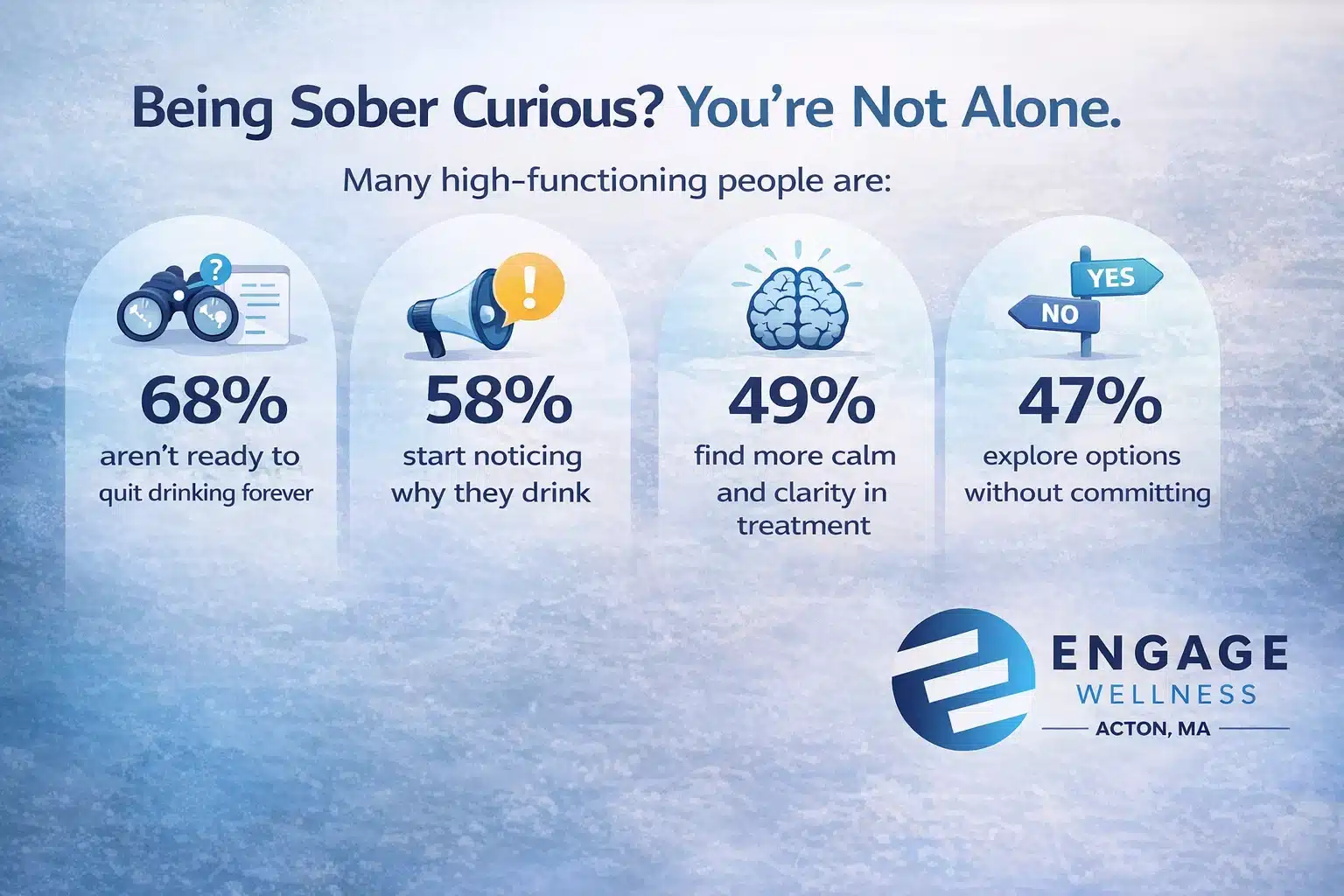
When alcohol is part of your routine, it’s hard to tell where choice ends and habit begins.
Treatment creates space between impulse and action. Instead of asking, “Can I stop?” the question becomes, “Do I want to?”
That distinction matters.
Clarity doesn’t come from willpower. It comes from awareness. Alcohol treatment helps you slow down long enough to see which parts of your drinking were intentional—and which were automatic.
Only then does real choice return.
For many people, the idea of lifelong sobriety feels overwhelming.
Alcohol treatment doesn’t require that promise.
Instead, it offers a trial period. A chance to experience life without alcohol—supported, structured, and without pressure to define the future.
This is often where clarity arrives.
Not in a dramatic moment, but quietly. Through better sleep. Calmer mornings. More presence in conversations. Less emotional whiplash.
Over time, the question shifts from “Can I give this up?” to “Why would I want to go back?”
One of the most powerful parts of alcohol treatment for sober curious individuals is realizing how many others feel exactly the same way.
In group settings, you hear:
There’s no pressure to adopt an identity. No expectation to declare certainty. Just shared honesty.
That kind of environment allows curiosity to breathe—and clarity to emerge naturally.
People expect clarity to arrive as an answer.
More often, it arrives as a feeling.
You notice you’re less anxious.
You feel more grounded in your body.
You respond instead of react.
You feel present instead of distracted.
Alcohol treatment doesn’t push you toward sobriety. It gives you the conditions to notice how life feels without alcohol—and whether that feels worth continuing.
That awareness is what makes any next step sustainable.
This matters, especially for sober curious people.
Treatment doesn’t strip away choice. It restores it.
Instead of drinking because it’s familiar or expected, you get to decide from a place of clarity. Whether you choose long-term sobriety or a different relationship with alcohol, that choice becomes informed rather than reactive.
That’s why many people seek help in recovery before consequences force the conversation.
They want understanding—not ultimatums.
One of the most common regrets we hear is, “I wish I’d done this sooner.”
Alcohol treatment isn’t only for moments of crisis. It’s for moments of honesty—when curiosity shows up before damage does.
We often support individuals from Medford, Massachusetts who begin treatment simply because something feels misaligned, even if everything looks fine from the outside.
We also work with people from Boston, Massachusetts who want space to explore change thoughtfully, without labeling themselves or rushing into decisions.
Wanting clarity is a valid reason to seek support.
You don’t owe anyone a diagnosis.
You don’t owe anyone a declaration.
You don’t owe anyone certainty.
Alcohol treatment gives you permission to explore quietly, intentionally, and with support—before you decide what comes next.
That alone can feel like relief.
No. Alcohol treatment focuses on how alcohol impacts your life, not on labels.
No. Treatment supports exploration and clarity, not forced decisions.
Length varies depending on individual needs and goals. Some people attend briefly for insight, others stay longer for support.
Yes. Uncertainty is often the reason people seek treatment—not a barrier to it.
Alcohol treatment helps you make informed choices. Whatever decision you make, it’s grounded in awareness rather than assumption.
No. Many participants are functioning well but seeking clarity before problems escalate.
If you’re sober curious and want clarity before deciding what alcohol should—or shouldn’t—look like in your life, you don’t have to figure it out alone.
Call (978) 699-9786 to learn more about how our Alcohol Addiction Treatment in Middlesex county, Massachusetts support thoughtful exploration, insight, and informed choice.
You don’t need a lifelong answer today.
You just need space to listen honestly.


© 2025 Engage Wellness. All Rights Reserved. Proudly Treating Drug & Alcohol Addiction in Massachusetts | SEO by DIGITECH | Sitemap | Privacy Policy