
Alcohol Treatment
Alcohol Treatment Gave Me the Tools — Learning How to Use Them Years Later Took Time

Written By
Alcohol Treatment
Written By
When I finished alcohol treatment, I imagined crossing a finish line. I expected clarity, peace, maybe even joy. And for a while, that’s exactly what I got. The structure. The support. The way people cheered for every milestone—it mattered.
But somewhere after the first year, things started to change. Not dramatically. I didn’t relapse. I didn’t fall apart. I just… flatlined.
I was still sober. Still grateful. But something felt missing. I didn’t know how to say it at first, even to myself: I got the tools, but I didn’t know how to build a life with them yet.
The beginning of recovery is like emergency surgery. You’re focused on stopping the bleeding. One day at a time, every day feels like a win. You’re busy with meetings, therapy, new routines. The adrenaline of changing your life keeps you moving.
But over time, the crisis quiets down. That’s when things got weird for me.
Without chaos, without the constant fear of slipping, I was left with space. And that space felt… empty. I wasn’t drinking, but I wasn’t really living either. Just existing. Floating. I started to wonder if I was broken—or worse, ungrateful.
The confusing part was this: I wasn’t in immediate danger. I had a job. I showed up for my family. I followed the rules of recovery. So why did I feel numb?
I told myself it was just a phase. Maybe it was hormones. Or the weather. Or boredom. But deep down, I knew it was something more.
What I really needed was permission—to admit that long-term sobriety can feel flat. That staying sober is not the same thing as feeling well. And that struggling without drinking doesn’t make you a failure. It makes you human.
I remembered all the tools from alcohol treatment: grounding techniques, coping skills, journaling, gratitude lists. I could recite relapse prevention strategies like a script. But when I felt disconnected, none of it felt relevant.
Because no one had told me how to use those tools when nothing was wrong but everything felt off.
Eventually, I realized the tools weren’t just for crisis moments. They were for maintenance. For curiosity. For checking in, not just checking out.
Recovery wasn’t about staying away from alcohol anymore—it was about learning how to return to myself, over and over again.
This was the loneliest part: I didn’t know who to talk to. Everyone around me seemed to be thriving. Sharing anniversary chips. Posting about gratitude and freedom.
I felt like the odd one out. Still sober, still showing up, but emotionally… tired.
Then I ran into an old group member from my time at Engage Wellness in Acton, MA, and we got coffee. About ten minutes in, she admitted: “I’m stuck. I’m doing everything I’m supposed to do, but I feel completely disconnected.”
It hit me like a wave of relief. I wasn’t the only one.
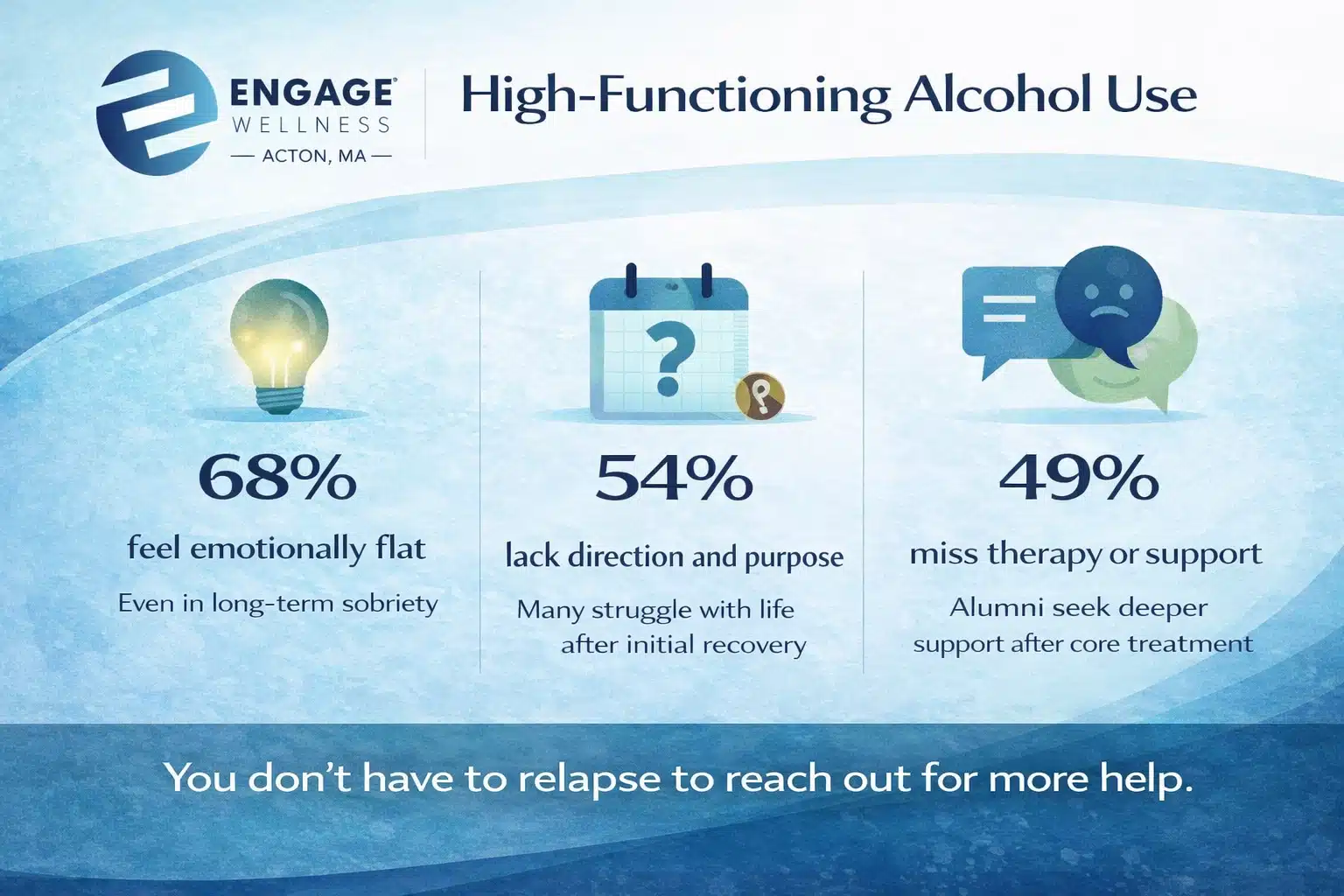
I used to think going back to treatment or therapy meant I had messed up. That I hadn’t learned “enough” the first time. But that’s not how healing works.
Healing isn’t a straight line. It’s a spiral. You revisit old lessons in new ways. And the fact that I wanted more from my sobriety? That was growth, not regression.
So I reached back out to Engage Wellness. Not because I was in crisis—but because I finally had the self-awareness to say: I need something deeper now.
They didn’t treat me like a dropout or a failure. They welcomed me with respect and understanding.
Early sobriety is all about building a new foundation. But long-term recovery? It’s about asking bigger questions.
I started therapy again—not because I was afraid of relapse, but because I wanted to feel things again. I joined a group—not to be accountable for sobriety, but to be honest about my life.
I learned that recovery doesn’t stop at stability. It continues into rediscovery. That’s the slow, often invisible work—and it’s just as important.
One of the myths I had to unlearn was this: that I had to be in crisis to ask for help. That unless I was at risk of relapse, I should just be grateful and keep moving.
But flatness is a signal too. Disconnection is its own kind of danger.
When you’ve been sober a while, people assume you’re fine. They stop checking in. You stop checking in with yourself. And suddenly, you’re drifting—not drinking, but also not fully here.
If that’s you, it’s not your fault. And it’s not permanent.
The biggest thing I’ve learned is this: alcohol treatment wasn’t a one-and-done deal. It was a beginning. A set of tools. A place I could return to, even years later, when I needed a tune-up or a new direction.
If Engage Wellness was where I learned to stop drinking, it also became the place I learned how to start living.
And that’s the work I’m doing now—not out of crisis, but out of curiosity. Because I want more. More presence. More connection. More meaning.
And I finally believe that’s okay to want.
Yes. Many people in long-term sobriety experience emotional flatness, spiritual disconnection, or a loss of direction. It doesn’t mean your recovery is failing—it means you’re ready for a new layer of growth.
Absolutely not. Treatment isn’t just for crisis. At Engage Wellness, we welcome alumni who are doing “okay” but want to feel better—emotionally, mentally, and spiritually.
We offer outpatient counseling, group support, and individualized therapy designed specifically for alumni. Whether you need a reset, a sounding board, or deeper self-work, we’ll meet you where you are.
That guilt is common—but misplaced. Wanting more support is a strength, not a weakness. You’re not regressing. You’re evolving.
If you’ve been wondering whether your recovery could feel richer, if you’ve felt stuck or emotionally distant, if you want more than just sobriety—you’re ready. Reach out. You don’t have to figure it out alone.
If you’ve been sober for a while and something still feels missing, listen to that voice. Not with panic—but with compassion.
Call (978) 699-9786 to explore how our Alcohol Treatment services in Acton, MA, Somerville, Framingham, Quincy, Lynn, Medford can help you reconnect—not just with your sobriety, but with the parts of you that still want to grow. You’ve done the hard part. Now let’s help you feel more alive in it.


© 2025 Engage Wellness. All Rights Reserved. Proudly Treating Drug & Alcohol Addiction in Massachusetts | SEO by DIGITECH | Sitemap | Privacy Policy